
DVD-quality lessons (including tabs/sheet music) available for immediate viewing on any device.
Take your playing to the next level with the help of a local or online mandolin teacher.
Monthly newsletter includes free lessons, favorite member content, mandolin news and more.
Premier Sponsors


|
Please note this is an archived topic, so it is locked and unable to be replied to. You may, however, start a new topic and refer to this topic with a link: http://www.mandohangout.com/archive/18603
South Hills - Posted - 12/29/2010: 03:29:35
After doing a lot of research, I visited Elderly Instruments in Lansing, Michigan and came home with a 1935 Gibson A-50 in the original case. Sounds great, looks great, and very reasonably priced. I strongly recommend that you visit Elderly's (with adult supervision) if you have never been there.
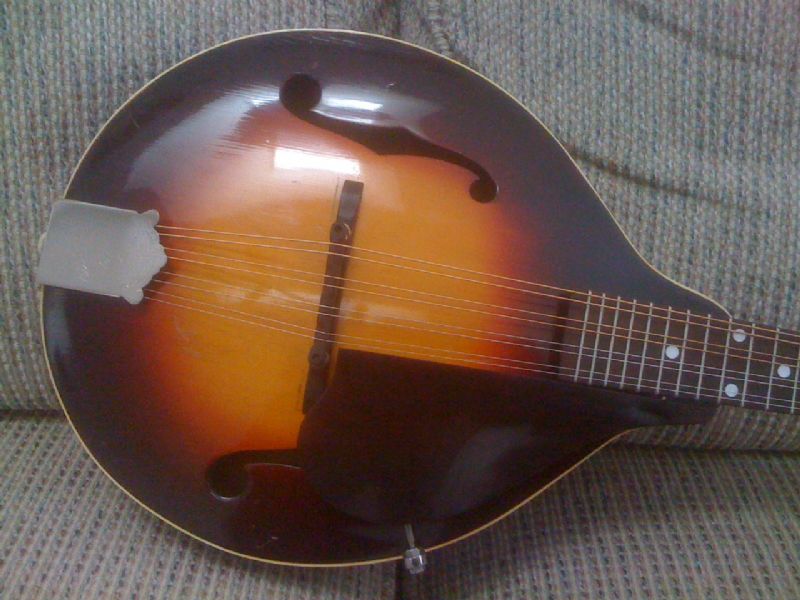 1935 Gibson A Style | 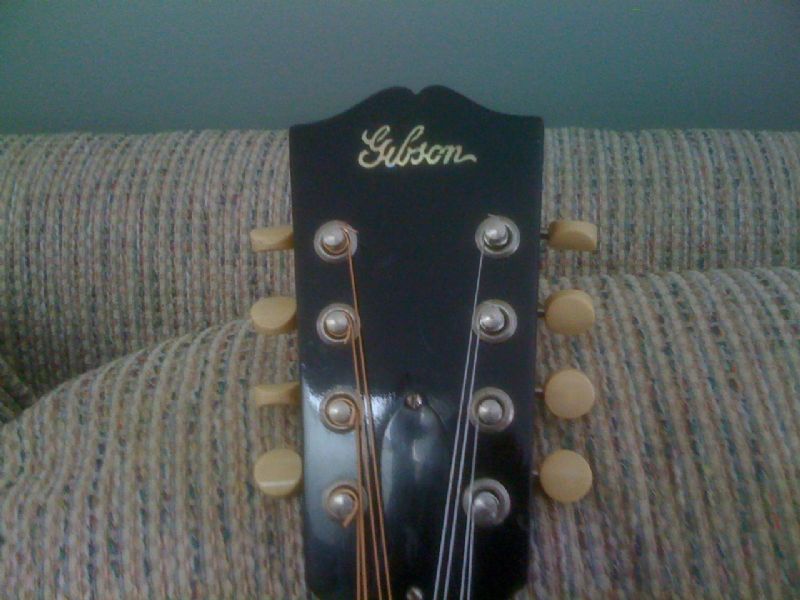 1935 Gibson A Style | 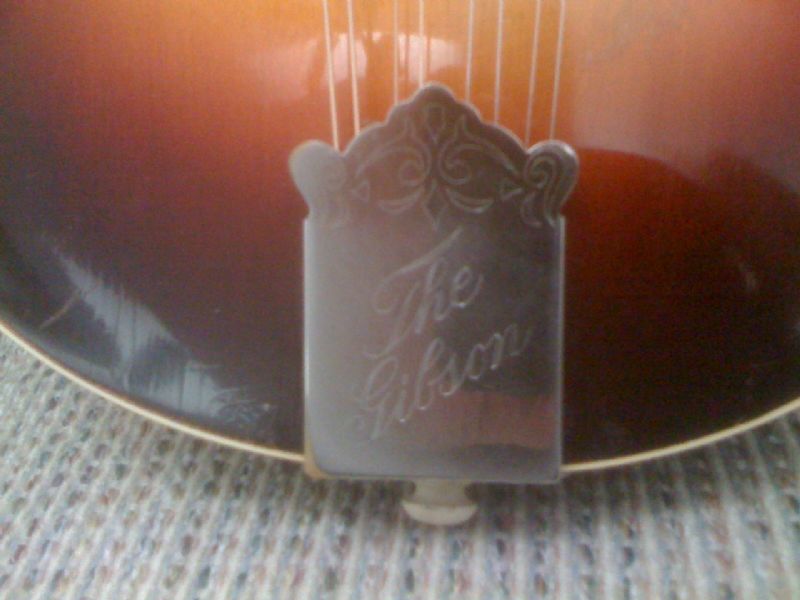 1935 Gibson A Style |
Bassora - Posted - 12/29/2010: 19:32:32
Haven't made it up to Elderly as of yet. Don't get out of Missouri very often.
Locally, Music Folk in Webster Groves, Missouri, is the place where you should only go with adult supervision . I've procured three of my mandolins there including two pre-WWII models.
Bassora
----------
Jim Yates - Posted - 12/29/2010: 22:07:03
I love those old A models. Even when I played bluegrass I didn't use an F model very often. I like the look of an A better than an F. I've heard a few pros say that the best sounding mandolin they've heard was the Loar A5 that once belonged to Tut Taylor.
Bassora - Posted - 12/29/2010: 22:24:53
I prefer A-models.
I prefer the feel of the shape of the A-model; doesn't feel awkward or too big.
F-models also look too fragile and too frilly to me. I just don't do frilly.
Bassora
----------
coelhoe - Posted - 12/30/2010: 09:22:09
Keep in mind that model for model and year for year both Gibson F and A models of the same price grade have the same size chambers. The scrolls and points are filled and are just for decoration. This was a revelation I had after I did play for a few minutes on that mystical Loar A5 that Taylor once had back in '73. All that extra money for a scroll is just for an expensive place to hang your strap.
The real difference in those 1930's-1960's Gibson A models is in the placement of the bridge and the scale length relative to the body (12 vs 14). The A-50's are maple and have good volume and a good "chop." Congrats!
Been doing business with Elderly since the mid-70's. Great guys!
Edited by - coelhoe on 12/30/2010 09:23:15
Muscle Tone - Posted - 01/03/2011: 19:07:25
I prefer A-models more than anything. I feel their louder, they have a better chop, and better sustain.
dmiller - Posted - 01/03/2011: 21:03:38
I used to have one that looked a lot like that one there many years ago.
I bought it from Tom's Picking Parlor on Kirkwood Avenue, in Bloomington Indiana.
This was back in the early 1970's. I was young and foolish then with no knowledge about instruments.
I kept the mandolin for about one month, then sold it because I convinced myself it wasn't genuine - - -
since the inlay of "Gibson" on the headstock was straight, instead of slanted like I'd seen it on guitars/ banjos/ etc.
I wish I knew then, what I know now. 
mandolen - Posted - 01/04/2011: 04:57:08
Coelhoe said: "The real difference in those 1930's-1960's Gibson A models is in the placement of the bridge and the scale length relative to the body (12 vs 14)."
Actually the scale length is the same at approx. 13 7/8" for both short and long neck models. The difference is the length of the neck (this is not the scale length) which joins at either 12th fret (short neck) or 14th to 15th fret (long neck). The bridge on short neck mandolins is moved off the center of the top and towards the tailpiece. The bridge on long neck mandolins is placed toward the center of the top, closer to the end of the fingerboard. The longer neck is also set at a steeper angle as a result. Bridge placement and neck angle are the main factors affected by the neck length. Hope this point is clear.
Len B.
Clearwater, FL
TI_USER - Posted - 01/08/2011: 13:32:49
quote:
The longer neck is also set at a steeper angle as a result. Bridge placement and neck angle are the main factors affected by the neck length. Hope this point is clear.
Red Henry - Posted - 01/10/2011: 10:41:36
Actually, it's possible that the older Gibson A models sometimes had a larger internal cavity than the F models. This shows up especially in increased bassiness, a department in which F models (especially modern ones with F holes) sometimes have a deficiency. I do believe that for this reason, among others (such as the fact that most modern F models have F-hole tops and the old A models have oval holes), you may find quite a difference in the sounds of the average A-model vs. F-model.
. . . . .
A note about neck length and neck-angle: The longer mandolin necks are typically built with a raised fingerboard extension, instead of having the fingerboard glued to the top. Because of this, it's easier to set the neck at a higher angle-- the neck doesn't have to be set at a continuation of the top.
Red
mandolen - Posted - 01/12/2011: 04:32:24
To expand on the neck angle point a bit further, use of a longer neck (without changing the 13 7/8" scale length) moves the bridge closer to the middle of the top. Also, the top is an arch (it has a curvature) so the bridge sits up higher on that arch than it would with a shorter neck. If the neck angle wasn't set back like it is, your bridge could only be about 1/2 inch tall in order to maintain the action (height of the strings above the fingerboard) in a playable range. This would cause all sorts of problems. The solution was to set the neck (relative to the plane of the body) at a more acute angle. This provides more space between the top and the strings to fit a taller bridge and avoid all those problems. Simple, elegant solution!!
Len B.
Clearwater, FL
Red Henry - Posted - 01/12/2011: 05:16:24
Right, and this was one of the Gibson company's great mandolin innovations long ago. Gibson had increased the neck-angle on their mandolins gradually through the early 1900s, and the bridges had slowly risen from a low strip of ebony to near their present height, but the fingerboards were still glued to the top. Finally, inspired by violin design, Gibson brought the idea to full development when they separated the fingerboard from the top and introduced the model F-5. Now, depending on how the neck is set, the only limits on bridge height are (1) its physical stability and (2) getting the bridge too high and restricting the top's vibrations with too much downward pressure-- which rarely happens, I think.
Other features of modern mandolins we also owe to the violin world. The carved top and back, present in Gibsons from the beginning, apparently were also inspired by violins, as were the revolutionary new f-holes in 1922.
Edited by - Red Henry on 01/12/2011 05:17:46
Terms of Use | Privacy Policy | Privacy Consent (EU/GDPR Only)
Copyright 2026 Mando Hangout. All Rights Reserved.


